May 25, 2026
Accessibility Is Not a Checklist
Google Research prototyped interfaces that adapt in real time to user behavior, with no accessibility menu required. For product teams, this changes what supporting screen readers means on the roadmap.
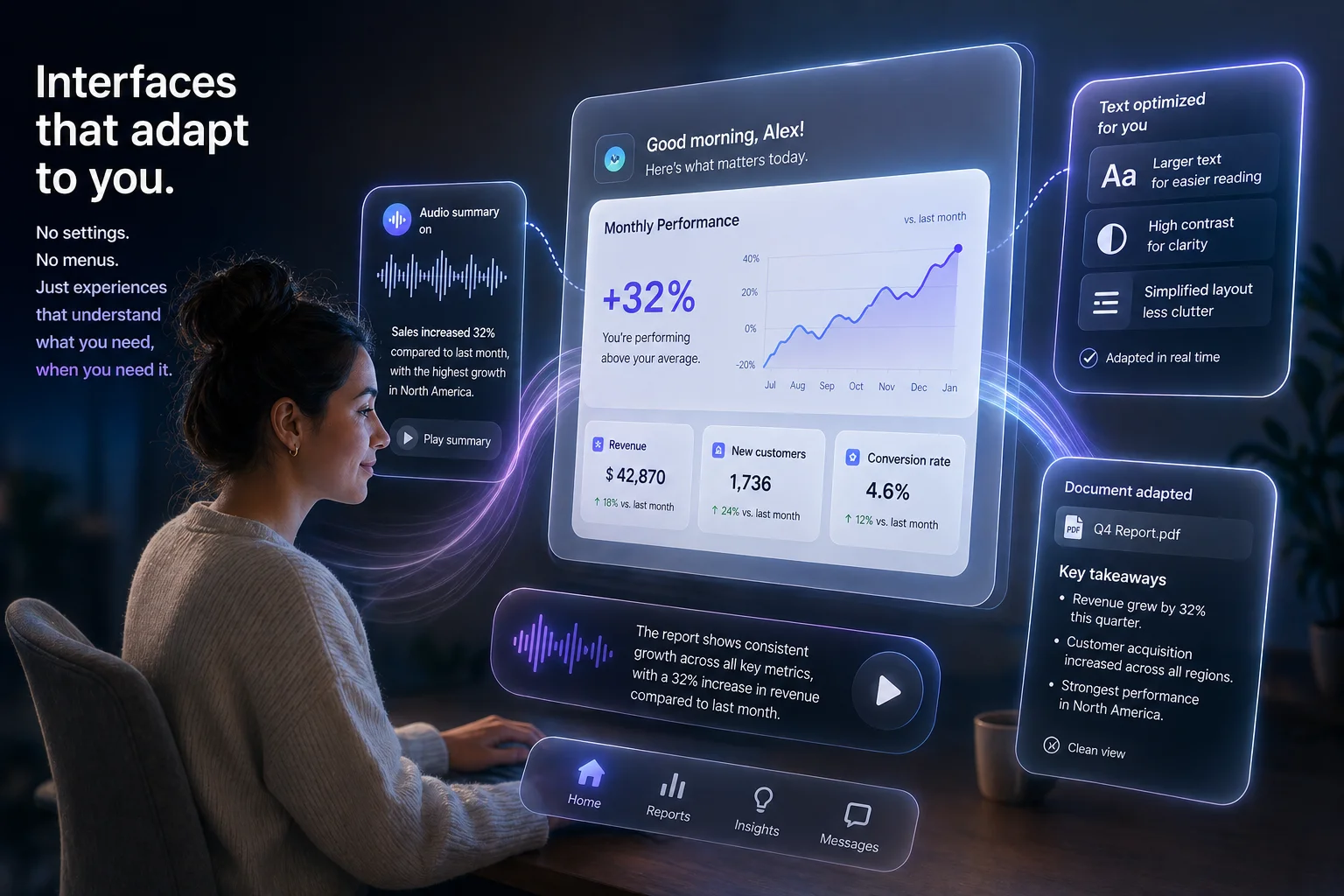
Imagine opening an app and, with no prior setup, it adapts the layout to your pace, describes in audio the chart that just appeared on screen, and reformats a document to make it easier to read. It would be great if something like that existed, right?
It is being prototyped right now, and it changes what accessibility means for product teams.
Google Research published in February 2026 the Natively Adaptive Interfaces (NAI) framework, where a main agent understands the user's goal and coordinates sub-agents that reconfigure the interface in real time: adjusting layout, scaling text, generating audio descriptions for blind users, simplifying pages for those who need less visual stimulation. The adaptation starts from user preference and behavior, not diagnosis. No accessibility menu to find. The product was designed to adapt from the start.
This logic has already reached screen readers. With Gemini integrated into TalkBack on Android, screen readers evolved from tools that describe what is on screen to agents that answer questions about the content. For product teams, this changes what "supporting screen readers" means on the roadmap.
Apple is building product infrastructure around this as well. Accessibility Nutrition Labels, announced at WWDC 2025, let users search the App Store filtering by VoiceOver support, voice control, and captions. Soon mandatory for new apps and updates. Accessibility becomes product metadata: visible, searchable, comparable.
Microsoft did not design Copilot for accessibility. A study by EY showed that 76% of neurodivergent employees reported better performance with it anyway. Features designed for a specific need end up improving the experience for everyone: voice control built for someone with a motor disability also works for a parent with a child in their arms.
There are 1.3 billion people with disabilities in the world. For decades, the conversation in product was about meeting requirements. What is being built now treats accessibility as what it always was: an architecture decision. Those who understand this first will serve the largest underserved segment in technology.
Sources: Google Research · Apple Developer · Microsoft Blog